Monday, August 13, 2012

paradigm shift

Amagansett: suddenly the coolest place in the world

Mary Heilmann, Kurt Gumaer, Seating Arrangements

ILLE Arts Seating Arrangements
curated by Mary Heilmann


Don Christensen, Songster, 2012, acrylic on wood table

It's nice to be surprised -- especially when it seems like there's no possible way to get it on in a way you haven't already considered a thousand times. Witness the transformation of sleepy little Amagansett, now the reigning champion in what is -- at least for this moment -- the East End's own Bushwick. It's fun and fresh and worth the long lines of beach traffic to get there.

Tucked inside a brief driveway off Main Street, Sara De Luca's new venture, ILLE Arts, offers crazy fun and varying degrees of comfort from this summer's break-out curator, Mary Heilmann. Selections here include Daniel Wiener, Don Christensen, Diane Blell and Kurt Gumaer as well as Heilmann's own hybrid seating units and succulent, crispy clear paintings.

Below, Daniel Wiener's weird and wonderfully incongruous painting/sculptures morph in between dimensions, Mandelbrot sets, and those trippy oil spills we used to watch before Uriah Heep concerts.  


Daniel Weiner, Plumbline of Disaster, 2010, Apoxie-Sculpt

Don Christensen's table paintings are a revelation -- so simple and perfect, and offering such satisfying solutions to the conundrum of 2 vs. 3 dimensions.

Don Christensen, Chicago Hoops, 2008, painted wood, furniture, hoops, wire


Kurt Gumaer, Webby Single bench, 2012, Pex tubing and painted plywood


Dan Colen at Karma

Dan Colen, 2012


And then! On to the newest of the new, book store and gallery, Karma, reincarnated from their west village location at Downing Street. Here, they are also tucked away, just a few steps from Main Street in a space that is big, flexible, and filled with cool.

And to cool off even more, check out Dan Colen both in Karma's gallery space and the adjacent lawn (above), dotted with chunky, sittable M&Ms -- hulking rocks painted in rich, candy-coated color.

More candy inside...


Dan Colen, Dead Flowers, 2012

Not unlike the confetti paintings he initiated after the death of his friend Dash Snow, here Colen provokes a literal mash-up -- in this case of mashed fresh flowers that are ground into the canvas. The results, a sort of visual epiphany that mingles aroma and detritus, violence and beauty, sweetness and despair. Colen is a balladeer -- given to poetics -- and, as such, well suited to the bookish Karma, one of those one-of-a-kind places for one-of-a-kind books and art, now in Amagansett. 


Dan Colen at Karma, 2012
Colen picks through the disenfranchised -- sifting through cultural throwaways and things in which any inherent significance has been eroded or disconnected from its origins -- and reconstitutes a visual language. His works can be transformative, elegiac -- even somber. (No somberness here!) 

His readymades possess the sort of urban poetry where meanings shift from ambivalence to certainty and from the poignant to the precarious. Above, his torqued park bench is an ode to imbalance -- urban, and a little madcap.


Not your typical bookstore

Watch for Adam McEwen's book signing at Karma on Sunday, August 19, 2 - 5pm 


Scott Bluedorn's 
Neoteric Fine Art
 
And then there's Neoteric Fine Art, now exhibiting Design + Function which includes works by the owner and curator Scott Bluedorn, surfboards by Stephen Jumper, as well as skate decks, textiles, jewelry and other outside the gateway buyables:

Neoteric Fine Art, Design + Function

Bluedorn is a surfer-traveler-artist-entrepeneur-jack-of-all-trades sort of guy whose gallery occupies a storefront on the highest order -- a vintage building situated directly on Main Street in Amagansett.

  
Victor-John Villaneuva, 2012, beads, resin
 
Below, Bluedorn addresses a chair with fisherman's nets and ropes -- all found among the marinas, streets, and beaches here. 


Scott Bluedorn, 2012

In the sister space across the hall, Bluedorn and co-curator Mark Wilson (check out Wilson's and partner Claudja Bicalho's awesome variety store, Lazypoint, just up the street) have assembled works that are cheeky, inventive and super seductive. 


Mark Wilson, Bear Medallion, 2012, digital print on canvas

Wilson works in a range of materials and idioms that bounce from the giant bear above, (a boy scout badge decal) to the sumptuous 17th century Persian carpet inspired oil paintings (below) he hangs on the wall or lays directly on the floor like actual rugs.


Mark Wilson, Persian Painted Rug, 2012, oil on canvas

Other works are equally sympatico, darting from artist-designed tables and chairs to driftwood configurations and oddly useful objet of all manner.


Ryan Bollman, Buoy, 2011, ceramic


Amagansett Village...best Sunday afternoon in a while.


Sunday, August 5, 2012

boy philosopher, white on white

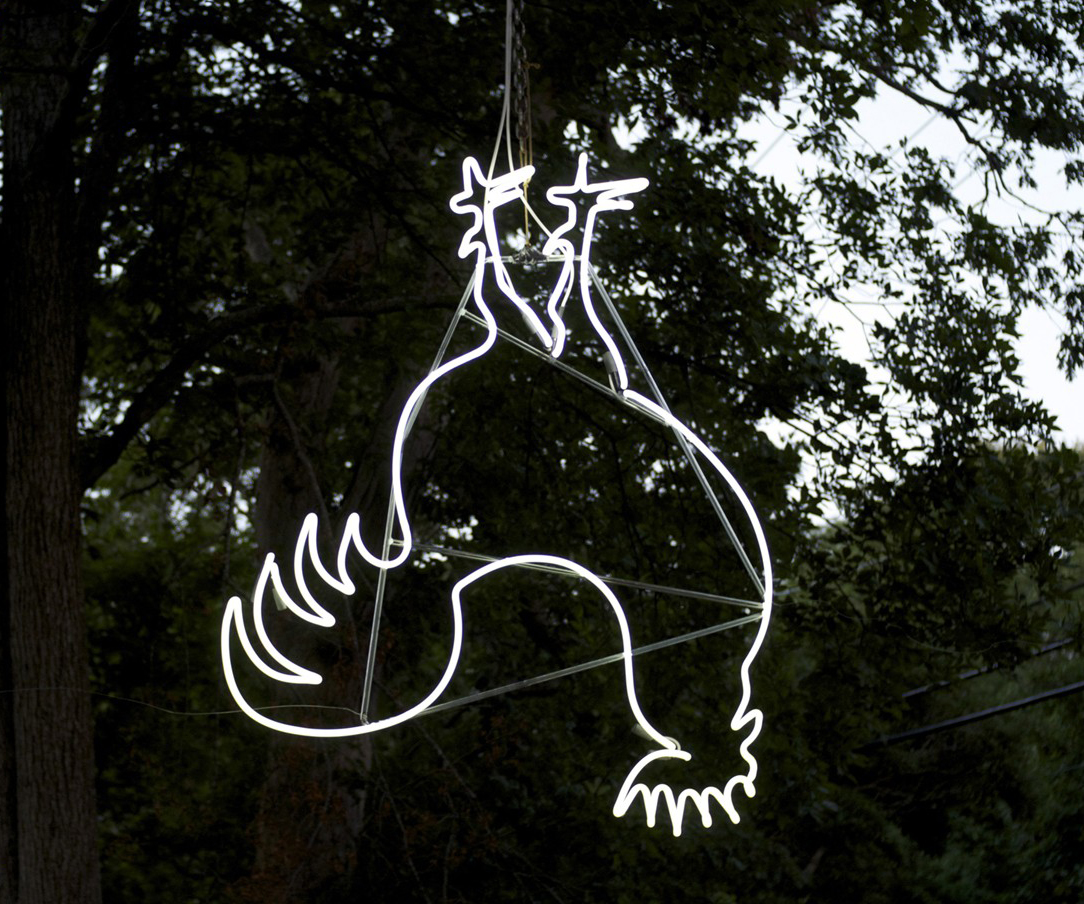
big white cock, 2012, neon tubing and wire, Ed of 3, 69 x 60 x 3 inches

Terence Koh
yes pleased
The Fireplace Project

It's not that you don't expect to see a neon chicken hovering between earth and sky in Springs...it's just that this neon chicken is upside down, hanging as if from a lynching or caught in a Chinatown restaurant window. That the original asianpunkboy a.k.a. Terence Koh has plugged in this particular chicken on the heels of the "Chic-Fil-A" melee -- yet another gross miscarriage of civil rights from the right -- is probably coincidence. Or...not?

On view at The Fireplace Project through August 12, the exhibit yes pleased features the above mentioned along with an installation of gold, marble, and au natural eggshells in a slightly ascetic and utterly surreal exhibition. 

Among these minimal subjects, symbolism abounds.
 

my mother destroyed me and still the tea iz the hope of my ship, 2012, eggshell gilded in 22 karat gold, Ed of 3


Of course, the proverbial golden egg came from a goose, not a chicken. Still, it's true that Aesop had the goose summarily executed -- an act of allegorical shortsightedness and greed in the extreme. Sound familiar? 

But for Koh, an artist whose body of work is both reverential and gleefully cultish, all allusions to meaning, metaphor, allegory, or semantics are purely conjecture. 

He's like a boy philosopher from a Jerzy Kosinski novel -- obtuse, poetic, obliquely political, and somehow, unequivocally divine.  Koh's surrealistic titles here, such as 
my son ate my family knot knowing about beauty, read like absurdist ballads or second cousins to Bob Dylan lyrics.

Koh is a consummate myth-maker, with one foot in the digital universe and the other planted squarely on terra firma. His website, books, and zines are a treat, his performances now stand alongside Chris Burden and Marina Abramovic, and his installations and projects feast on alchemy, fetishism, ambiguity, and comicality.


Witness his 2011 exhibition nothingtoodoo at Mary Boone, where he circled an immense salt pyramid on his knees during gallery hours -- nearly all day every day -- for five weeks. The margins of his pain threshold within reach, on occasion he was prostrate.


Much has been written about Koh -- Vito Schnabel has perhaps the best handle on this exhibit, featured on his Huffington Post page. Check it out here.


And by the way, stay away from those chicken sandwiches.


Saturday, July 28, 2012

my home town meets Jessica Stockholder:

jessica stockholder: color jam


'color jam' by jessica stockholder at the intersection at state and adams, chicago, USA


Happy to see the second city engaging in some first tier public art -- nothing new for the new and improved Chicago, where public art reigns.

When I was little, Picasso's gigantic Untitled sculpture was installed at Daley Plaza. It was the event of the decade for this kid who hadn't even lived a decade. Slowly, since then Chicago has been gaining momentum as one of the great places to see and experience public art. Bravo all around.


From designboom:

american artist jessica stockholder's 'color jam' installation sees a downtown chicago intersection awash with color. the artist envisioned a 'three-dimensional painting', with color spilling out of windows, through doors, and onto the buildings and sidewalks of the crossroads of state and adams.'color jam' is chicago's largest public art project to date and was commissioned by the chicago loop alliance - it will remain in place until september 30, 2012.


'color jam' by jessica stockholder

---
following text from the official press release


walk on, in, and through the canvas of renowned artist jessica stockholder this

summer with color jam.

the fictive potential of surface, so thoroughly cultivated through the history of

painting, is always ready to burst, spilling forth imagined richness, full of emotional,
subjective resonance, and wandering focus is here woven together with the
more mundane everyday surface of the street corner. the piece celebrates
and demands that the evocative surface of this chicago street corner be expanded.
the corner is canvas, stage, pedestal, and frame against which the public can
view a parade of shifting color relationships.”

'color jam' is part of art loop, an award-winning series that activates the

loop with contemporary art. previous art loop installations include
tony tasset’s eye and cardinal (2010) and kay rosen’s go do good (2011).

on display through september, color jam' invites the public to participate

in a series of programs—or jams—taking the form of concerts, talks, and
happenings throughout the loop. in addition, several loop businesses
are offering color jam-themed specials, ranging from color-tinis
to jammin’ hotel discounts.


'color jam' by jessica stockholder


'color jam' by jessica stockholder


'color jam' by jessica stockholder


'color jam' by jessica stockholder


'color jam' by jessica stockholder


'color jam' by jessica stockholder


color jam sketch by jessica stockholder


Friday, July 20, 2012

some like it hot


Buy My Bananas
curated by Julia Trotta 

Excellent summer sizzle at Kate Werble Gallery where curator Julia Trotta has mounted a smart and sassy riff on male anatomy. Her long list of artists includes steamy works by Amanda Church, Aura Rosenberg, Martha Friedman, Anne-Lise Coste, Kathe Burkhart, Linda Lighton, and more (!!), whose visual banter and jock-u-larity are a perfect summer treat.

Trotta, the granddaughter of feminist super-intellect, Linda Nochlin, trades on gram's groundbreaking research to shed a little light between the sheets.

Observing the bounty of dirty pictures featuring women engaged in all manner of folderol with fruit and vegetables, in 1972 Nochlin produced "Buy My Bananas," a spoof on mid-19th century porn and the vintage "Buy My Apples," left. Her long-haired subject, a male model at Vassar, was only to happy to oblige the famed professor who shot three pictures of him poised just so. Nochlin wasn't a professional or even part-time photographer -- this was the only significant photo she ever took -- and it was to become the prototypical dick joke for the literati. 


Aura Rosenberg, The Dialectical Porn Rock, 1989-2012
The good thing about pornography is its "last frontier" status. Seeing it where you least expect it -- like a gallery -- allows even the most mild porn to be a little bit brazen, excitable, provocative. It's especially effective in Trotta's
selections here, which range from ribald to whimsical. In Aura Rosenberg's The Dialectical Porn Rock, what began as a practical joke has developed into a trans-national form of installation art. Rosenberg laminates pornographic images on to rock formations that show up installed at various locations -- always where you least expect them -- across the U.S. and in Germany, Switzerland and Italy. It's a cultural rubble that dovetails nicely (and purposefully) with Robert Smithson's landmark essay, The Dialectical Landscape.


Amanda Church, Man with a Big Heart, 2010, oil on canvas

Amanda Church presents a big, glamorous canvas saturated with electric color, salacious curves and liquid, voluptuous form. She's not shy, and here her insinuations of the carnal present a refreshing sexual etymology that is animated, satiric, and delicately naughty -- like Mondrian meets Elizabeth Murray meets Peter Max.

Below, a few images from this fun and provocative show, on view through August 2nd.

Martha Friedman, Tongue Flag, 2010, silicone, rubber, and fiberglass reinforced FGR

L: Kate Burkhart, Cunt, 2010, acrylic on canvas; R: Linda Lighton, Diva, 2000-06, clay, glaze, lacquer


Anne-Lise Coste, Smile at Dice, 2012, spray paint on canvas


Thursday, July 19, 2012

super cool off Springs-Fireplace

Nick Dine, installation view: Tatum O'Neal, Toddlers and Tiaras, the Sag Harbor Gulf sign...it goes on and on

L.O.S.
SUPERLEGGERA PROJECTS
Nick Dine
Peter Dayton
Gregory Johnston


Peter Dayton

Race cars, punk rock, color bars, and puppies...what's not to love? 

At Superleggera Projects, a hideaway studio-cum-gallery in East Hampton, industrial designer and occasional gallerist Nick Dine joined forces with Peter Dayton and Gregory Johnston to mount one kick-ass summer show filled with crisp color, neat corners and an abundance of cool.


Dine's super-charged imagery -- piled ceiling high on the northwest walls -- samples images from television and film, motor sport and a little bit of Americana in the form of a Gulf Oil sign that was left to the elements off of Route 114 in Sag Harbor. With zippy red pigment cascading down its face, the gasoline sign looks like an ancient bas-relief, circa 1970. Tatum O'Neal tops a bank of photos that includes strident images from TLC's reality show, Toddlers and Tiaras, one of the 21st century's truly disturbing iterations.


Gregory Johnston

Gregory Johnston's color saturated compositions exude racing car elegance. It's no surprise then (but it is!), that his palette is derived from the automotive design industry. A long- time race car devotee, Johnston's enamel on aluminum paintings are buoyant and crisp, sharing the sort of spatial clarity of high-end automobiles like the Lamborghini Superleggera Gallardo (in Italian, "super light"):


just saying....Lamborghini Gallardo Superleggera

Peter Dayton's party is in full swing here with mural size record album paintings that do double-time. They employ pop imagery that trades on record label design, nostalgia, and good old vinyl culture. His surfboard panels pay homage both to Frank Stella and to big wave culture with priceless, minimal compositions that are so cool they steam in this summer air.


Peter Dayton


Selected works by Gregory Johnston are currently on view at Eric Firestone Gallery. Nick Dine's super contemporary design products include furnishings, flooring, and shelving for clean, modern living.


Gregory Johnston


Sunday, July 15, 2012

open book

Steve Miller, Global Outpost, 2011, inkjet and silkscreen on canvas, 40 x 60 inches
Steve Miller                      
Saúde do Planeta 

Steve Miller's new works, now on view at Harper's Books, stand in the cross hairs of the nature/culture divide.In Saúde do Planeta (Health of the Planet), Miller weds art and intellect in a body of work that celebrates the beauty and peril of the Brazilian rainforest, one of the most bio-diverse ecosystems in the world.

Snake River, 2011, silk-screen book, glass, steel, 29 x 28 1/2 x 6 inches

Miller, a born and bred New Yorker, began to x-ray Amazonian plant species during a 2007 sojourn to Brazil. The resulting imagery, elegiac and gossamer, focused on the plight of the rainforest, endangered by uncontrolled deforestation that claims -- worldwide -- over 6,000 acres per hour. Miller, who refers to the Brazilian rainforest the lungs of the planet, started traveling there as often as possible. He learned Portuguese, found a hospital to assist in creating digital x-rays of flora and fauna, and became indebted to the idea of planet earth and its future as his subject matter. Since then, Miller's works have become symbolic of a planet in the throes of utter sacrifice -- one in which humankind's progress has superceded the most basic needs of the planet.


Rio Gato, 2009, acrylic & silkscreen on canvas

For Miller, art and technology met in the 1980s when his first experiments with computers began.

Since then, his oeuvre has grown to include research into particle physics, molecular biology, archeology, technology and here and there, throwing paint.


At Harper's, he goes one further. Merging this electric imagery with customized book editions, the new works are sculptural tomes that integrate gesture, intellect, the organic and the scientific. A book resides within each sculpture, opened behind glass to one of many pages that have been addressed by Miller with silkscreens of various cross-sections of nature vs. culture. The sculptures can morph at will, just by turning a page. 


Steve Miller and I exchanged a few thoughts by email earlier this week:
 
JG: How do you generate the x-rays of animals?

SM: The Amazon animals were all found in collaboration with Brazil's oldest environmental research institute in Belem, on the Amazon river. I worked with a zoo, a local aviary and a fishery. In the case of the alligator, we transported a live (but sedated) alligator in the back of a pickup truck to a radiology clinic in Belem. The mouth of the alligator was bound with a rope. Under these circumstances, this specimen was most cooperative and then I took the digital x-ray. I visited all the animals the next day in the zoo -- they seemed to have a good attitude about having participated in the project. 

The piranhas was a request I made to some fishermen in the local market. They caught the piranhas in the morning and I packed them on ice for their evening at the radiology clinic. The chest of ice leaked in my hotel room and in the tropical heat, the stench of fish permeated my room for a week.

 JG: How do you choose which books you'll utilize -- how does your imagery relate, or not relate, to the content of the book?

SM: All the books are chosen for their content. Many are about Brazil, or the environment. Al Gore's book, Earth in Balance, is one -- it's an important piece of world awareness regarding the health of the planet. The book is part of a sculpture in which a snake swallows a rat. To make the sculpture complete, I asked Vice President Gore to sign the book.


SM: Often, on top of the page of these books I silkscreen images of the wires from the favelas (the ghettos or shanty towns found outside urban areas) in Rio. These wires represent the uncontrolled and chaotic need for the resources that are pictured in the books. 


JG: Has learning to speak Portuguese revealed anything to you about Brazilian culture?

SM: You can enter a larger cultural conversation that would otherwise exclude you if you can only operate in English. Portuguese is a necessity if you are anywhere except Sao Paulo and Rio de Janeiro. My Portuguese is pretty basic -- I can have a conversation and ask directions. Believe me, when the car breaks down in Bahia and no one speaks English, that's where the rubber hits the road.

Also, Portuguese is a romance language and when you listen to the lyrics of Vinicius de Moraes you hear poetry that reflects the spirit and beauty of Brazil. The flow of Brazilian Portuguese is rhythmic, musical and sensual.


Radiant child, indeed.

The show is on view through August 13th.


Saturday, July 7, 2012

pixels/paints/politics

Satellite-Dubai, 2012, mixed media on canvas over wood, 36 x 60 inches

Perry Burns
A Picture's Half Silence
Sara Nightingale Gallery

During a workshop in Turkey two years ago, among the transnational population of Arabs and Muslims, Africans and Kurds, a mélange of westerners and myriad other demographics, Perry Burns suffered a conversion. Suddenly the world -- so awash in political unrest, bloodshed, economic crises, and cultural myopia -- beseeched him to address its ruptures not only through his conscience but through his art. Burns retrenched, and some of the most stunning results of this new body of work are currently on view at Sara Nightingale Gallery.

Jali, 2012, mixed media on canvas, 48 x 48 inches

Throughout his artistic evolution, Burns' abstract paintings have embraced sumptuousness and sensuality -- buttery paint application,  complex layers of pattern and ornamentation, and luscious color -- but even the most robust composition could not address this artist's cultural third eye. And so, like a magnifying glass in the sun, he turned his focus squarely on the sorts of global issues that confront us every day: The Arab Spring, Iraq and Afghanistan, Syria, Africa, and the politics, intolerance, and civil unrest that haunts the broad landscape of our times.

Jali is latticed screen, often carved in stone
In the painting Jali (above), Muslim women adorned in stylish hijabs gather beneath Burns' application of a QR code lookalike or pixelated screen. 

An instrument of modesty, morality, and Muslim faith, the headscarf has seen renewed popularity since 9/11. Though the hijab and burqa are not without controversy in the Middle East, what the west widely views as an emblem of gender oppression is more often considered an affirmation of Muslim identity among the women who choose to wear them. Here, Burns invites us to examine the politics of the veil through a camouflage that reiterates the jali latticework so typical of Islamic architecture. These ubiquitous carvings, some dating back to the 12th century, are rigorous and labyrinthine. 


The pre-industrial meticulousness of jali invokes notions of meditation and fidelity and Burns employs the metaphor with striking affect. The partially redacted women appear both precious and imperiled, their obfuscation both an armament and a symptom of the cultural cross hairs by which they are often defined. 

Satellite Oman, 2012, mixed media on canvas over wood panel, 36 x 60 inches

For Burns, who is also an aspiring photojournalist, photography is the bellwether of cultural accountability, and the degree to which it is capable of providing the truth to us is incalculable. In the satellite paintings, he utilizes images of global surveillance that speak to a chilling reality: the entity holding the camera is Big Brother.

In Satellite Dubai, Burns addresses the image of this United Arab Emirates region with a smack of red and green, creating a visual friction that begs the question -- are these images based on reconnaissance?  Random pictures of earth? Coordinates for drone targets?


Satellite Hindu Kush, 2012, archival pigment print, 23 x 23 inches
Merging this degree of hot emotional content with the sort of acid-burn invoked by complementary colors provides a spectacular contrast both pictorially and intellectually.

Burns has said, "My work is most fundamentally about the politics of seeing," and here he reminds us that visual fact can be at the root of a pilgrimage through civilization.

As Perry Burns carves through the 
cultural minefields of the 21st century, 
his aesthetic decisions function like a modern cento (the poetic form that 
draws from passages and verse from 
other authors) in which fragments of global politics, technology, and world events, are collaged together to form new meaning. 


Hijab/Veil, 2012, mixed media on canvas, 48 x 48 inches

Don't miss this provocative show, on view through July 30th.